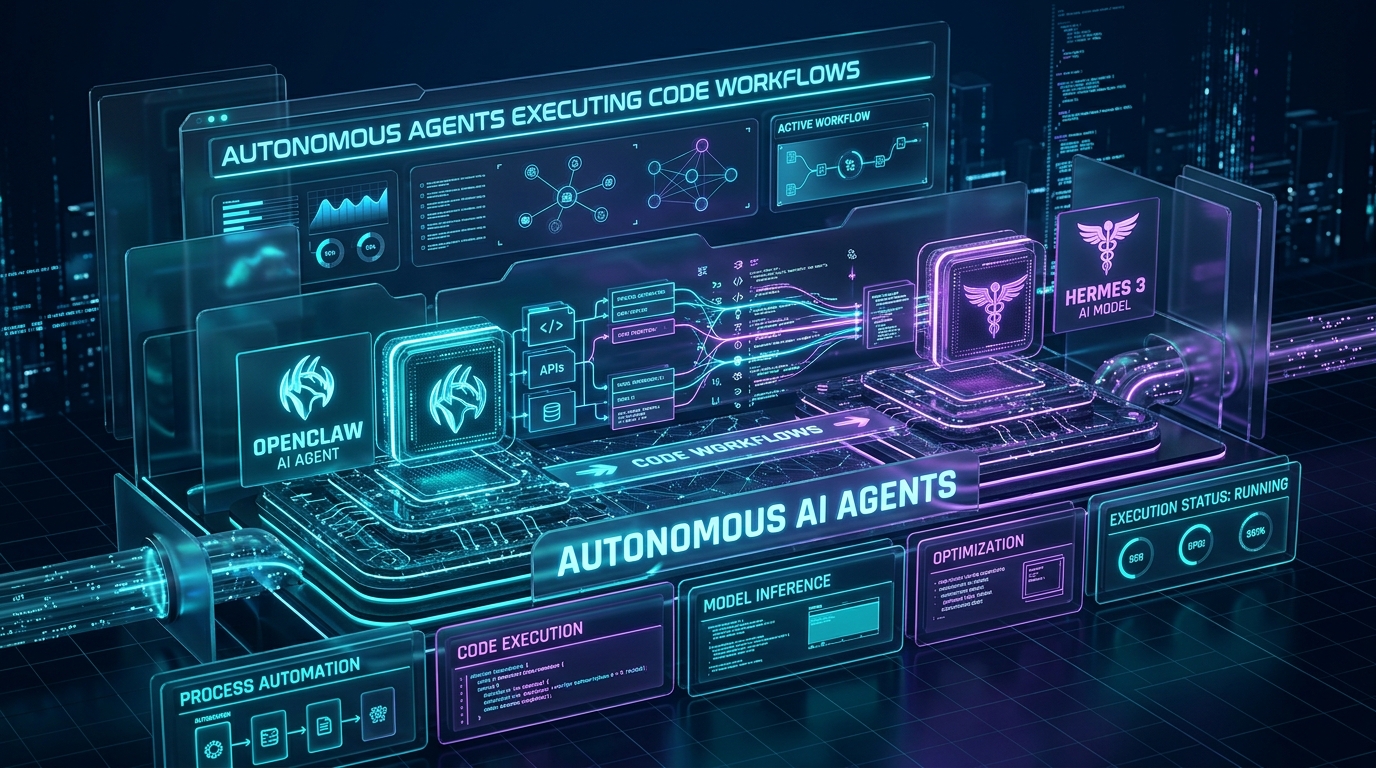
In 2026, Artificial Intelligence hit a decisive milestone: we moved from conversing with Q&A chatbot widgets to deploying autonomous AI agents capable of executing complex engineering, finance, and operational workflows without continuous human supervision.
Next-generation models and agentic frameworks like OpenClaw and Hermes 3 have redefined enterprise automation. Unlike traditional single-prompt API calls, an autonomous agent possesses long-term memory, self-correction code capabilities, and multi-step reasoning.
The Anatomy of an Enterprise Autonomous Agent
A modern AI agent operates on a continuous Perception-Reasoning-Action loop (ReAct Loop):
- Perception and Context: The agent receives a high-level goal (e.g., "audit repository security vulnerabilities and open a pull request with code patches").
- Task Decomposition: Breaks the goal down into sequential executable sub-tasks.
- Tool Calling and Execution: Accesses command terminals, vector databases, and external APIs via standard protocols like MCP.
- Verification and Self-Correction: Runs automated unit tests. If tests fail, it parses the compiler error trace and refactors the code automatically.
"We replaced 15 manual bank reconciliation scripts with a crew of Hermes 3 agents using in modern engineering teams. Processing time dropped from 4 hours to 90 seconds with zero margin of error." — Tech Engineering Report, 2026.
OpenClaw vs. Hermes 3: Which One to Deploy in Production?
OpenClaw: Specialized in software development tasks, local file system manipulation, and automated DevOps pipelines. Ideal for infrastructure agents.
Hermes 3: High-precision open reasoning model fine-tuned for complex instruction following, financial modeling, and decision-making under uncertainty with zero hallucinations.
Enterprise Governance and Agent Sandboxing
Granting execution privileges to AI models demands strict security boundaries. in modern engineering teams, we enforce Docker container sandboxing, gated human-in-the-loop approvals for destructive write actions, and immutable audit logs to ensure enterprise AI agents operate safely within human oversight.
Real-World Enterprise Agent Case Studies
In Latin American fintech, autonomous agents are processing real-time bank statement reconciliations. Instead of brittle legacy scripts breaking on minor PDF format changes, a Hermes 3 agent parses structural documents, infers transactional schema, and verifies records against PostgreSQL databases.
Tool Integration and Security Governance
- Real-Time Action Auditing: Every terminal command or database query issued by OpenClaw is written to an immutable event store.
- Human-in-the-Loop Gating: Destructive actions like dropping database tables or emailing clients require explicit manual approval via Slack.
- Semantic Cache Latency Reduction: Repetitive LLM queries hit Redis Vector Search in under 10ms.
Adopt autonomous agents in your enterprise to eliminate toil and empower your human team to focus on strategic innovation.
Real-World Agentic Performance Benchmarks
Comparing OpenClaw and Hermes 3 against standard LLMs on real-world engineering benchmarks (SWE-bench) demonstrates autonomous agents solving complex repository issues at a 42% success rate. The difference lies in their ability to execute terminal commands, read build error logs, and iterate on code refactors autonomously.
Enterprise Tool Integration
in modern engineering teams, we interface autonomous agents with Slack, Jira, GitHub, and relational databases via secure MCP servers. This enables product managers to type natural language commands like "audit the last 5 commits and build release notes," getting verified outputs in seconds.
Implementation Methodology and Enterprise ROI
Deploying these advanced technical architectures across enterprises in LATAM and the United States proves that success lies in measuring direct business impact: slashing operational overhead, accelerating Time-to-Market delivery, and raising end-user satisfaction. in modern engineering teams, we guide your engineering teams through every phase, ensuring clean code, thorough documentation, and knowledge transfer.
Summary and Key Technical Takeaways
- Baseline Technical Audit: Evaluate current infrastructure readiness before initiating major architecture migrations.
- Proof-of-Concept Pilot Testing: Validate changes in isolated Staging environments prior to production release.
- Continuous Observability: Deploy real-time APM monitoring to guarantee service level agreements (SLAs) remain strictly above 99.9%.