
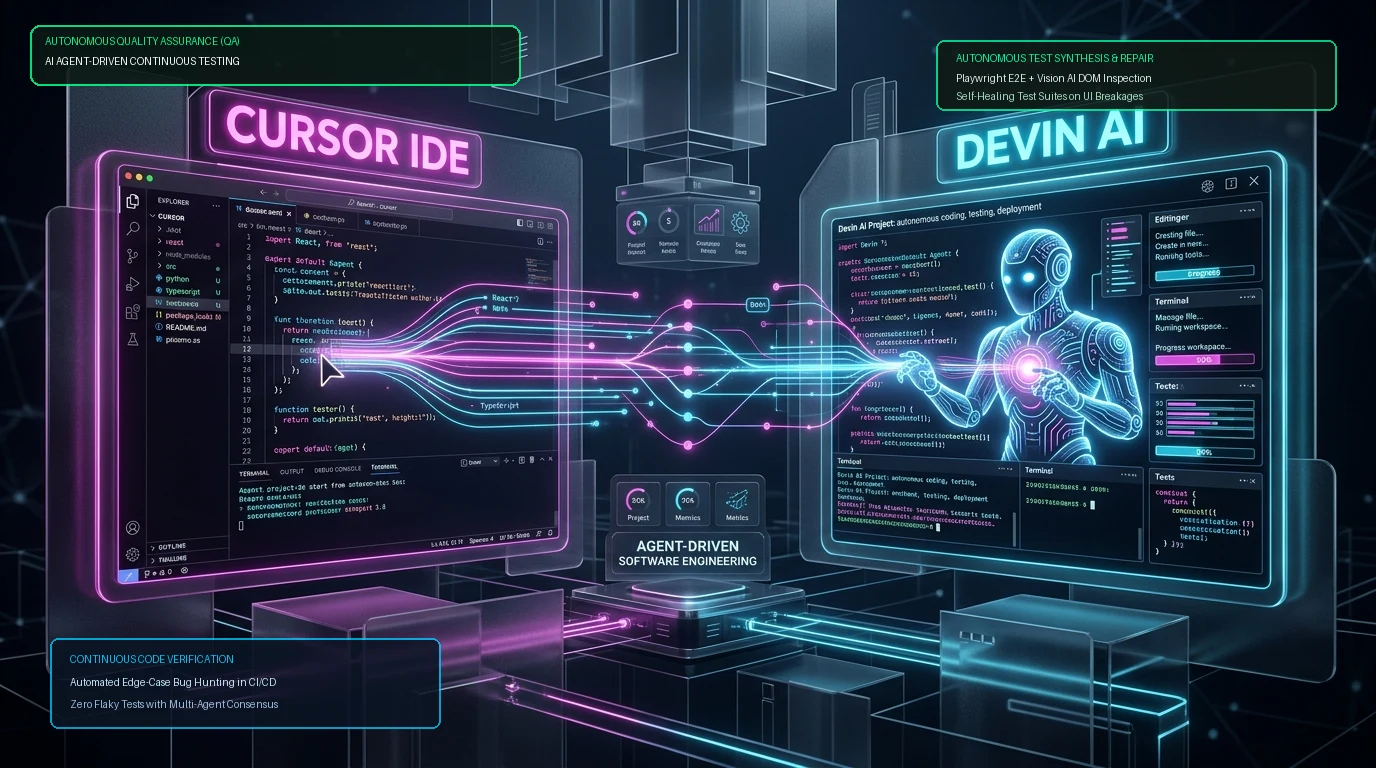
Software Quality Assurance (QA) has historically stood as one of the most tedious bottlenecks in rapid continuous delivery pipelines. In 2026, the maturity of Autonomous QA and Agentic Testing Systems has fundamentally elevated how modern engineering teams validate platform stability.
Legacy end-to-end testing with brittle CSS selectors routinely broke whenever design systems updated class names or element layouts. In contrast, 2026 QA agents bypass fragile selector paths by combining multimodal computer vision with deliberate reasoning models to inspect and navigate user interfaces exactly like human users.
"The frontier of QA is no longer hand-crafting assertion scripts: it is dispatching an autonomous agent that navigates the build, formulates destructive chaos scenarios, flags visual regressions, and generates self-healing patches."
Core Capabilities of Autonomous QA Agents
- Autonomous E2E Test Synthesis: Given user story specs or a newly staged branch, the agent synthesizes robust Playwright/TypeScript test suites covering end-to-end happy paths and boundary conditions.
- Self-Healing Test Suites: When a legitimate UI redesign breaks an old selector, the agent visually identifies the intended target element, updates test fixtures automatically, and unblocks the CI/CD pipeline.
- Visual Regression & WCAG 2.2 Accessibility Audits: Instant flagging of layout clipping, responsive breakage, and color contrast non-compliance across desktop and mobile viewports.
- Proactive Chaos & Edge-Case Probing: Simulating erratic real-world user behavior: rapid-fire clicks, simulated network packet drops, unicode fuzzing, and boundary value mutations.
CI/CD Integration & Automated Remediation
- Zero-Friction PR Validation: Every pull request triggers sandboxed autonomous test runs complete with session video replays and DOM state traces.
- Automated Bug Patching (Auto-Fix PRs): For predictable syntax errors, missing form validations, or conditional render bugs, the agent synthesizes ready-to-merge corrective patches.
- 80% Reduction in Test Maintenance Overhead: Engineering squads focus on building high-value product features instead of constantly rewriting flaky test fixtures.
Flawless Software Engineering with Ingruvo
At Ingruvo, we integrate Continuous Verification and Autonomous QA protocols across all client deliveries. We engineer mission-critical digital products backed by resilient automated testing, guaranteeing frictionless deployments and world-class user experiences.