
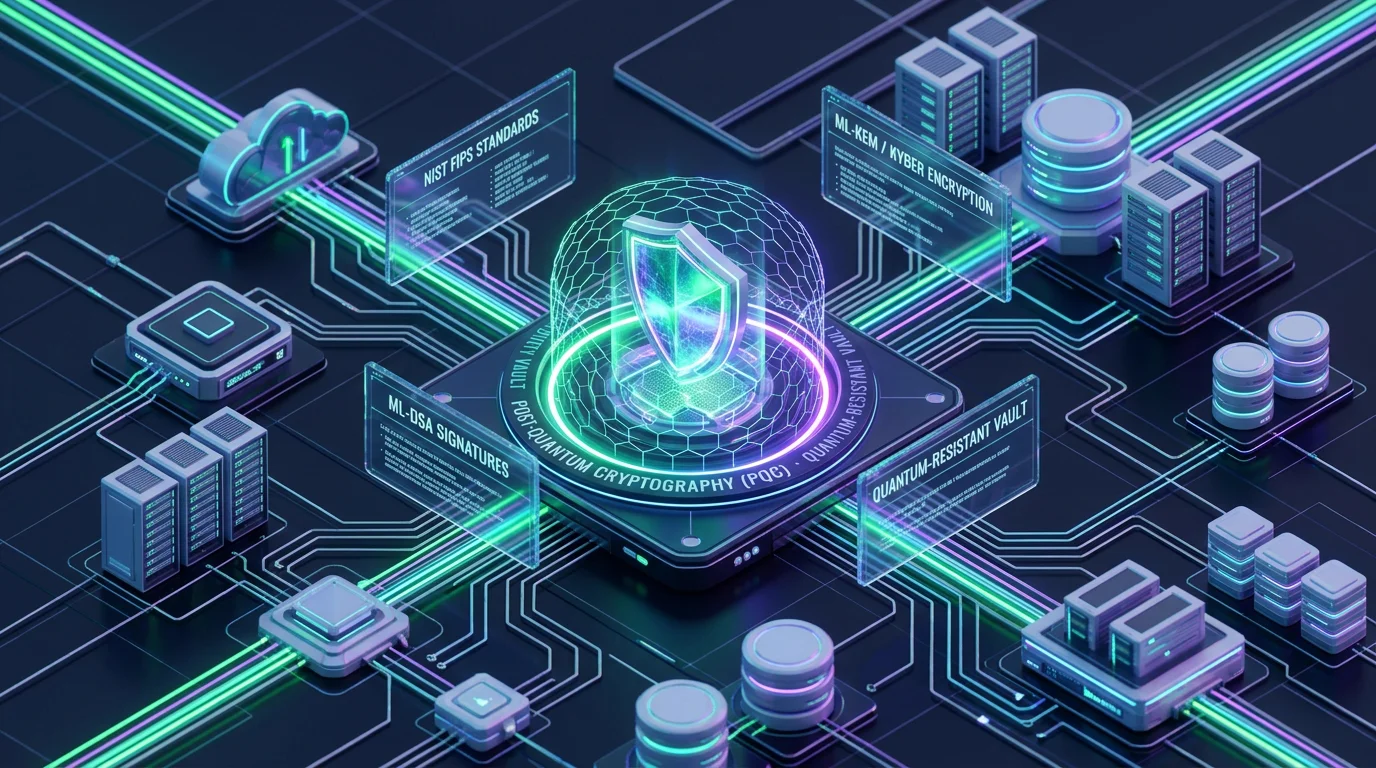
Quantum computing has moved from theoretical physics into an urgent cybersecurity priority. Organizations that fail to begin transitioning toward Post-Quantum Cryptography (PQC) risk having their proprietary data permanently compromised in the near future.
The most immediate threat is not waiting for a commercial quantum supercomputer: it is the 'Harvest Now, Decrypt Later' (HNDL) attack pattern. Adversaries are actively capturing and archiving encrypted enterprise traffic today, intending to decrypt it once quantum hardware capable of running Shor's algorithm on RSA and Elliptic Curve Cryptography (ECC) becomes accessible.
"Any confidential asset with a shelf life exceeding five years—intellectual property, clinical records, or enterprise trade secrets—is already exposed if transmitted over legacy cryptography."
The New NIST FIPS Standards for Post-Quantum Cryptography
The National Institute of Standards and Technology (NIST) has officially released the finalized Federal Information Processing Standards (FIPS) based on hard lattice mathematics:
- FIPS 203 (ML-KEM / CRYSTALS-Kyber): Primary standard for key encapsulation and secure session establishment across TLS tunnels and VPN backbones.
- FIPS 204 (ML-DSA / CRYSTALS-Dilithium): Primary standard for digital signatures, identity verification, and token attestation.
- FIPS 205 (SLH-DSA / SPHINCS+): Stateless hash-based digital signature backup ensuring redundancy against potential lattice vulnerabilities.
The Demise of RSA and ECC
Traditional asymmetric schemes (RSA-2048, ECDSA, Diffie-Hellman) rely on integer factorization or discrete logarithms—problems that Shor's algorithm solves in polynomial time. In contrast, lattice-based cryptography constructs multidimensional geometric lattices where computing shortest vectors remains mathematically intractable for both classical supercomputers and quantum processors.
Achieving Cryptographic Agility in Enterprise Stacks
Transitioning to PQC requires a methodical approach known as Cryptographic Agility:
- Deploy Hybrid TLS 1.3: Enable hybrid cipher suites (such as X25519 combined with ML-KEM) on edge load balancers and CDNs to protect current sessions while maintaining backward client compatibility.
- Inventory Public Key Infrastructure (PKI): Audit root X.509 certificates, code signing pipelines, and JWT signing keys across all corporate microservices.
- Upgrade Cryptographic Engines: Modernize runtime dependencies to OpenSSL 3.3+, BoringSSL, or Rustls with native support for FIPS 203/204 algorithms.
Post-Quantum Security Engineering with Ingruvo
At Ingruvo, we audit cloud infrastructures and design Zero Trust architectures built to withstand the quantum era. We harden corporate APIs, encrypt databases at rest with post-quantum standards, and establish resilient crypto-agile pipelines to guarantee long-term data sovereignty.