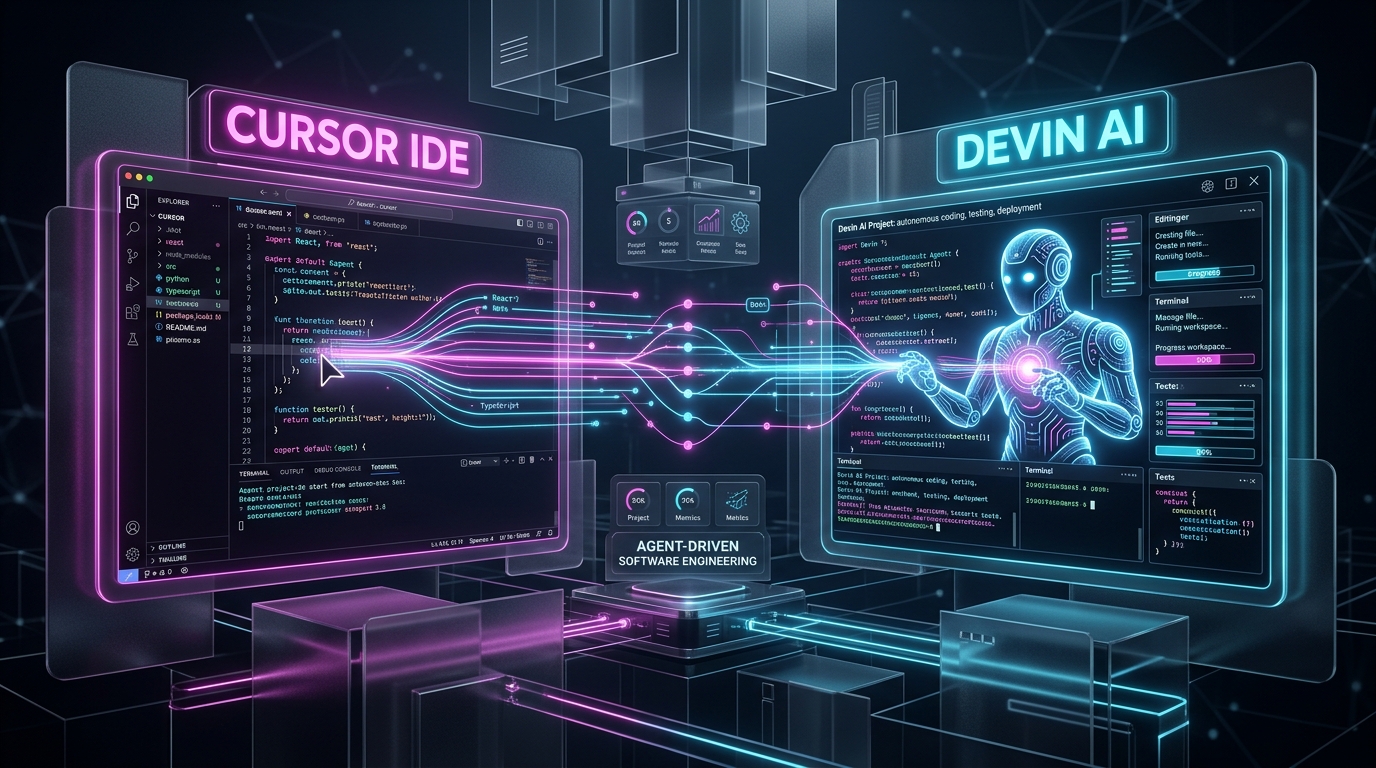
The software engineer role has transformed more over the past 24 months than in the preceding 20 years. Writing syntax line by line is no longer a developer primary competitive edge; today success lies in architectural supervision, spec definition, and AI code agent orchestration.
Agentic IDEs like Cursor and autonomous software environments like Devin have multiplied tech delivery speeds by 5x. A senior developer paired with AI agents builds complete enterprise systems in days rather than months.
The 3 Levels of Agentic Integration in Engineering
- Level 1 — Contextual Autocomplete: Inline code completions aware of open project files.
- Level 2 — Multi-File Prompt Editing: The agent analyzes the entire codebase and applies coherent refactors across 10 files simultaneously.
- Level 3 — Autonomous Bug Resolution: The agent reads a Jira issue ticket, reproduces the bug in a container, writes the failing test, fixes the bug, and submits a GitHub Pull Request.
"in modern engineering teams, we embraced Agent-Driven Development natively. Our engineers do not spend their days typing repetitive boilerplate; they focus on system design, security, and business value." — CTO, in modern engineering teams.
Preparing Your Enterprise Codebase for AI Code Agents
AI code agents perform best on well-structured repositories. To maximize accuracy with tools like Cursor and Devin, establish: clean documentation inside `.cursorrules` or `AGENT.md` files, strict typing with TypeScript or PHP 8.x, and an automated unit test suite the agent can run to validate code refactors.
The Future of Enterprise Software Engineering
Adopting agent-driven development does not mean fewer engineers — it means engineering teams delivering 5x more value in the same timeframe, clearing legacy technical debt, and shipping products in weeks.
The Business ROI of Agent-Driven Engineering
Companies adopting agentic software workflows cut feature delivery costs by up to 60%. Delegating unit test writing, boilerplate HTML/CSS coding, and CI deployment setups to AI agents frees senior engineers to focus on business logic and architecture.
Best Practices for Agentic Engineering Teams
Maintain modular codebase boundaries, write concise spec docs in Markdown prior to prompting, and enforce automated static code checks (PHPStan, ESLint) inside GitHub Actions to validate agent contributions before merging.
Implementation Methodology and Enterprise ROI
Deploying these advanced technical architectures across enterprises in LATAM and the United States proves that success lies in measuring direct business impact: slashing operational overhead, accelerating Time-to-Market delivery, and raising end-user satisfaction. in modern engineering teams, we guide your engineering teams through every phase, ensuring clean code, thorough documentation, and knowledge transfer.
Summary and Key Technical Takeaways
- Baseline Technical Audit: Evaluate current infrastructure readiness before initiating major architecture migrations.
- Proof-of-Concept Pilot Testing: Validate changes in isolated Staging environments prior to production release.
- Continuous Observability: Deploy real-time APM monitoring to guarantee service level agreements (SLAs) remain strictly above 99.9%.
Key Technical Architecture Takeaways
Building high-availability B2B software in 2026 requires unifying modern cloud infrastructure, strict cybersecurity guardrails, and AI automation. in modern engineering teams, our engineering team partners with enterprise leaders across LATAM and North America to architect scalable web apps, custom Moodle learning portals, and native AWS cloud systems.
- End-to-End Encryption: Forced TLS 1.3 in transit and KMS encryption at rest.
- Sub-Second Response Times: Edge caching and DB index optimization for peak performance.
- AI Integration: Production-grade RAG and MCP connectors with zero data leaks.