The AI gold rush has driven hundreds of companies to integrate language models (LLMs) without a clear business case, burning budgets on OpenAI or Anthropic APIs with zero ROI. in modern engineering teams, we guide decision-makers to separate genuine technological innovation from marketing hype.
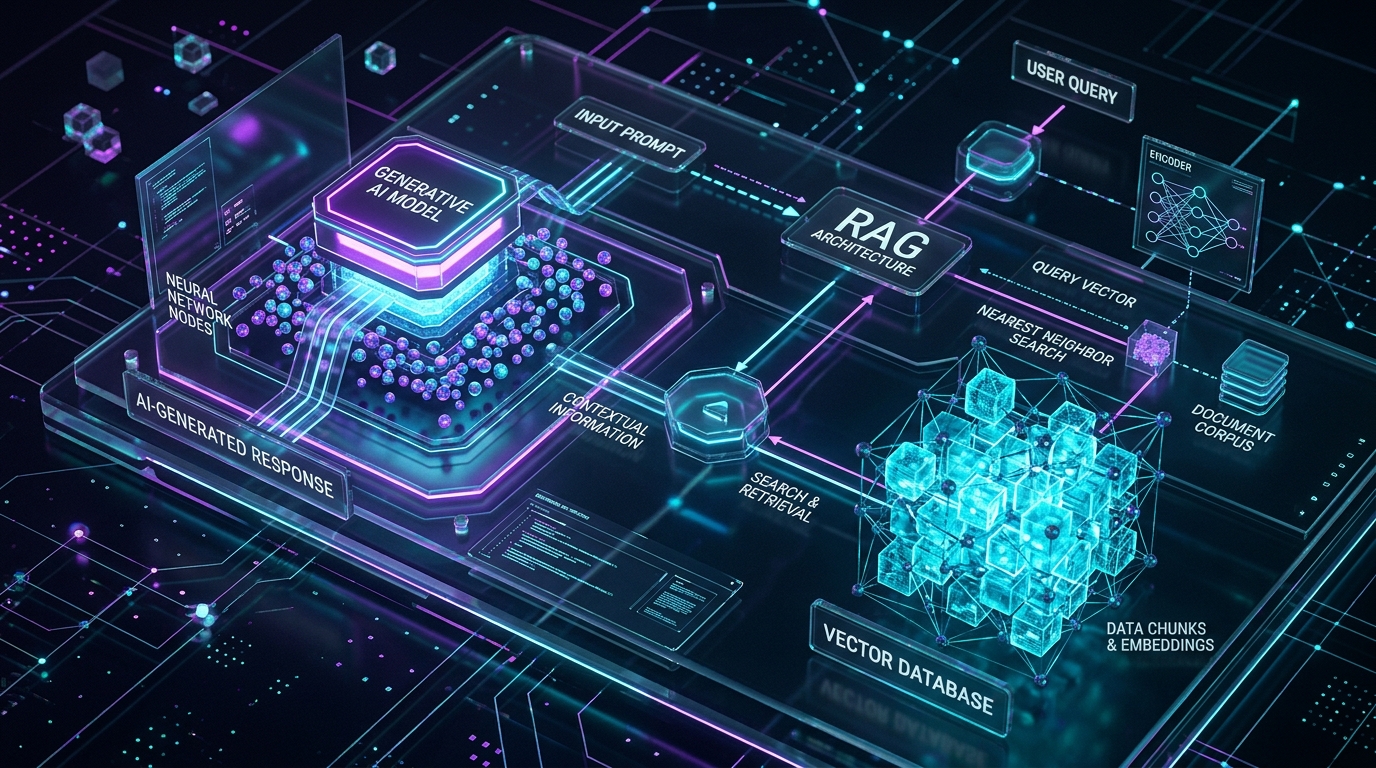
Integrating AI into your platform is not about pasting a generic chatbot widget on your website. It is about automating complex business workflows with RAG (Retrieval-Augmented Generation) architectures connected to your private enterprise database.
What is RAG and Why is it Superior to Generic LLMs?
RAG allows an AI model to query your company's private documentation (technical manuals, knowledge bases, procedure PDFs, internal policies) before formulating an answer. This eliminates model 'hallucinations' and guarantees accurate, verifiable, and confidential answers.
- Data Privacy: Your company's sensitive data is never used to train public third-party models.
- Optimized Cost: You only transmit relevant text chunks to the model per query, reducing token usage by over 80%.
- Real-time Updates: Updating your knowledge base does not require re-training the model; updating vector embeddings is instant.
"in modern engineering teams, we deployed an internal RAG assistant for 150 engineers. Search time in technical manuals dropped from 45 minutes to 12 seconds per query." — CTO, Industrial Firm, Bogota.
The 4 High-ROI Use Cases in B2B Operations
- 1. Automated Document Processing: Parsing PDF invoices, purchase orders, or legal contracts and dumping structured JSON directly into your ERP/CRM with zero human error.
- 2. Tier-1 Customer Support: Virtual assistants trained on official internal docs resolving up to 75% of incoming tickets without escalation.
- 3. Executive Report Generation: Summarizing complex spreadsheets and transactional logs into crisp narrative executive summaries.
- 4. B2B Sales Copilots: Analyzing historical CRM touchpoints and recommending personalized follow-up actions for each account.
API Cost Estimation & Financial Sustainability
A common pitfall is ignoring per-token API operational costs. Running un-cached GPT-4o or Claude 3.5 Sonnet queries on 10,000 daily requests can generate multi-thousand-dollar monthly bills. in modern engineering teams, we build semantic caching layers (Redis Vector Search) and hybrid local LLMs (like Llama 3 on private VPS) to slash API overhead by over 70%.
Production-Grade AI Security Protocol
When deploying Artificial Intelligence in enterprise environments, setting strict privacy and data governance policies is critical. in modern engineering teams, we build input sanitization layers (Prompt Injection Armor), PII data masking pipelines, and immutable audit logging. This prevents confidential customer or business data from ever leaking to third-party public models.
Furthermore, we engineer hybrid offline fallback architectures (local Llama 3 models) to guarantee uninterrupted uptime even during third-party API outages or latency spikes.
Enterprise Governance & Compliance in AI Workflows
Beyond privacy, enterprise AI deployments require operational auditability. Every query routed through your custom RAG system must be logged with user context, timestamp, and retrieved document references. in modern engineering teams, we build administrative control panels that allow CTOs and compliance officers to review AI responses, set content guardrails, and track API token usage across organizational departments in real time.