
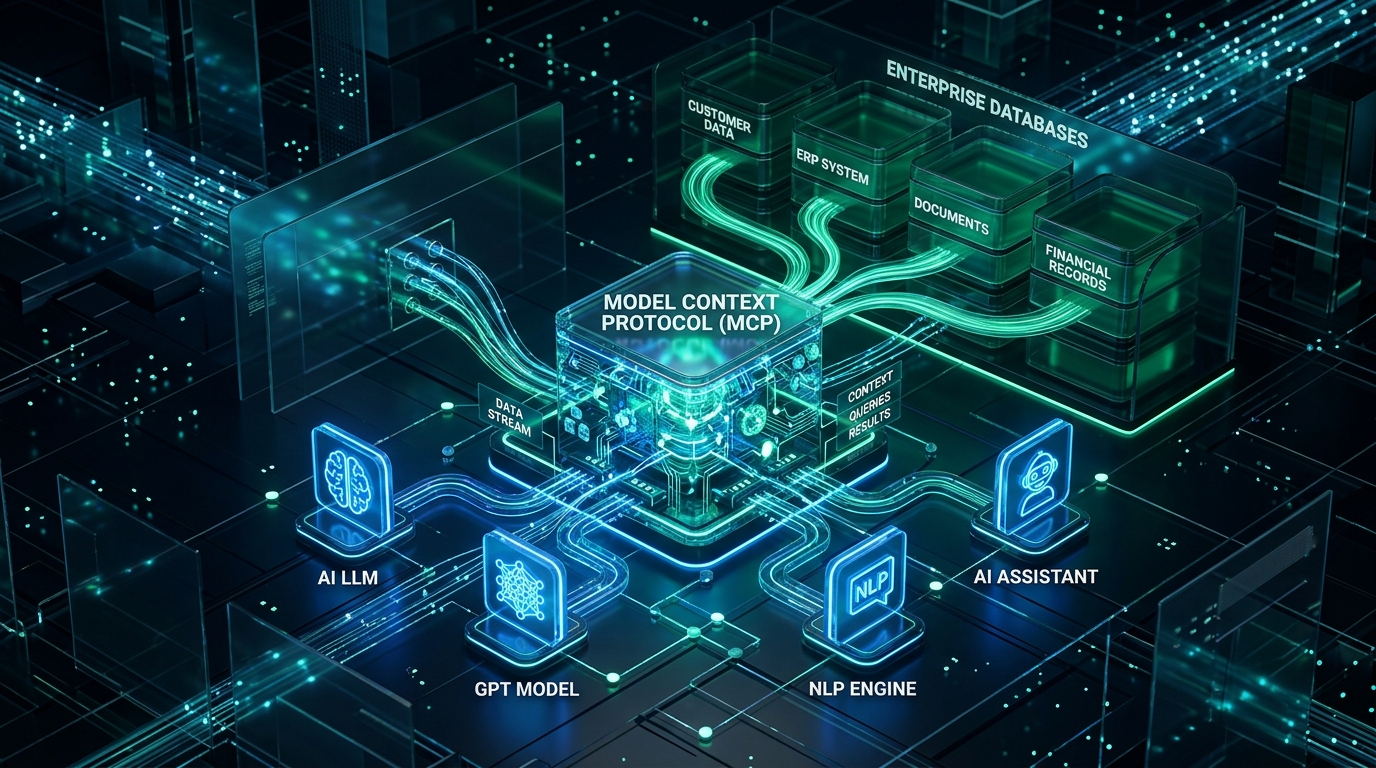
Before the Model Context Protocol (MCP), connecting a language model (LLM) to your company database required writing brittle custom APIs, glue middleware, and fragile wrappers that broke with every SDK update. MCP changed the game permanently.
Engineered as an open client-server standard, MCP allows any AI client (Cursor, Claude Desktop, custom enterprise agents) to securely discover and interact with local or remote tools, databases, and APIs without custom integration code.
How the MCP Architecture Works
MCP relies on a crisp three-layer architecture:
- MCP Host / Client: The AI application (e.g., Cursor IDE, custom corporate assistant) initiating context queries.
- MCP Server: A lightweight program exposing specific system capabilities (e.g., PostgreSQL MCP server, GitHub MCP server, Jira MCP server).
- Resources and Tools: Structured data payloads and executable functions made available by the server to the AI client.
"Deploying internal MCP servers across our infrastructure cut the integration time for new AI assistants from 3 weeks down to 15 minutes." — Cloud Architecture Community.
Strategic Enterprise Advantages
- Total Interoperability: Switching LLM providers (e.g., from OpenAI to Claude or Llama 3) requires zero rewriting of database connectors.
- Security by Design: MCP servers run inside your private VPC or local environment. DB credentials are never transmitted to third-party model APIs.
- Dynamic Tool Discovery: AI agents automatically discover available database schemas, endpoints, and tools in real time.
Step-by-Step MCP Server Implementation
Exposing enterprise data to AI agents via MCP involves building a lightweight Node.js or Python server using the official MCP SDK. The server defines Tools like `get_user_by_id` or `search_invoices` with strict Zod validation schemas. Compatible MCP clients connect via stdio or encrypted Server-Sent Events (SSE).
Production MCP Enterprise Use Cases
- IDE Code Assistants: Developers querying staging DB schemas directly inside Cursor IDE without window switching.
- Automated Support Agents: Support bots querying live ERP order statuses in real time via MCP connectors.
- Cybersecurity Audits: Security agents querying AWS CloudTrail logs through dedicated MCP servers.
The Future of Enterprise Integration with MCP
Model Context Protocol is rapidly becoming the HTTP equivalent for the AI era. By adopting MCP, organizations avoid proprietary vendor lock-in, ensuring their enterprise data layer remains accessible to any future AI agent or model without rebuilding integration pipelines.
Granular Security and Access Control in MCP
MCP servers engineered in modern engineering teams enforce JWT authentication and role-based access control (RBAC) lists, restricting database tables, columns, and API endpoints accessible to AI agents based on logged-in user permissions.
Implementation Methodology and Enterprise ROI
Deploying these advanced technical architectures across enterprises in LATAM and the United States proves that success lies in measuring direct business impact: slashing operational overhead, accelerating Time-to-Market delivery, and raising end-user satisfaction. in modern engineering teams, we guide your engineering teams through every phase, ensuring clean code, thorough documentation, and knowledge transfer.
Summary and Key Technical Takeaways
- Baseline Technical Audit: Evaluate current infrastructure readiness before initiating major architecture migrations.
- Proof-of-Concept Pilot Testing: Validate changes in isolated Staging environments prior to production release.
- Continuous Observability: Deploy real-time APM monitoring to guarantee service level agreements (SLAs) remain strictly above 99.9%.