
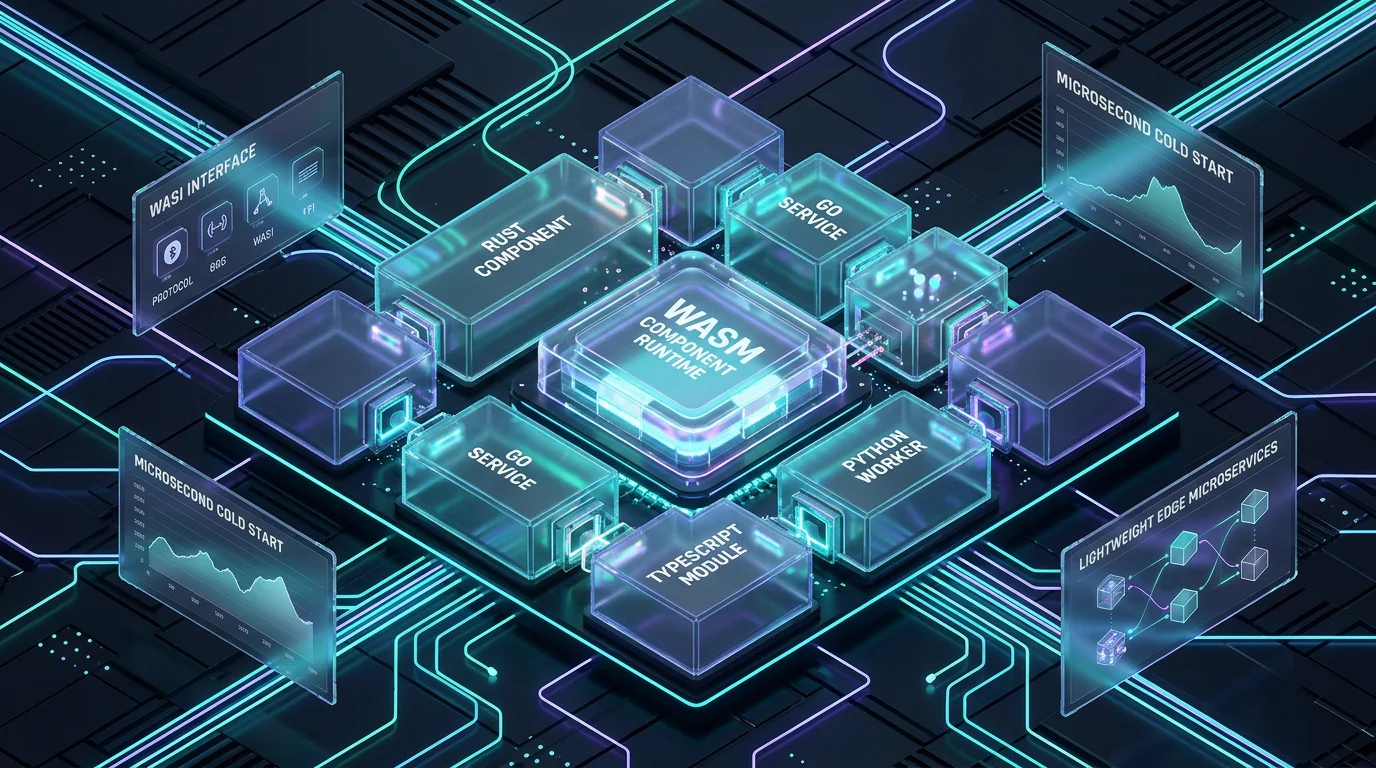
Docker and Linux containers transformed software distribution over a decade ago. However, bundling 200MB operating systems just to run five-line microservices is increasingly inefficient. In 2026, WebAssembly (Wasm) and the Component Model represent the next evolutionary step in cloud computing.
WebAssembly is no longer confined to running high-performance graphics inside browser viewports. With the stabilization of WASI (WebAssembly System Interface) Preview 3 and the Component Model, Wasm has become the universal runtime for polyglot microservices, extreme edge workloads, and zero-latency serverless applications.
"While a typical Docker container suffers 200ms to 1.5s cold start latency, a WebAssembly component instantiates in under 10 microseconds while consuming mere kilobytes of memory."
What is the Wasm Component Model & WIT Interfaces?
Previously, polyglot software engineering required deploying separate microservices communicating over gRPC or HTTP networks, incurring heavy JSON serialization penalties and network hops. The Component Model solves this through high-level contract definitions known as WIT (WebAssembly Interface Types).
Engineering teams can compile a cryptography engine written in Rust, a business model in Go, and routing logic in TypeScript, linking them into a unified secure sandbox process without network boundaries or inter-process communication overhead.
Wasm vs Docker: Real-World Engineering Benchmarks
- Cold Start Speed: Containers must initialize kernel namespaces and virtual filesystems (300ms–1500ms). Wasm modules execute in ~5 microseconds.
- Memory Footprint: Base containers require 40MB–150MB at idle. Wasm components run smoothly on under 60KB of RAM.
- Capability-Based Security: Wasm binaries run inside an airtight sandbox with zero access to filesystem, network sockets, or system clocks unless explicitly granted by host capabilities.
- Native OCI Distribution: Wasm components are packaged, tagged, and distributed using standard OCI container registries (AWS ECR, Docker Hub, GHCR).
Distributed Orchestration with wasmCloud and Edge Compute
Platforms like Cloudflare Workers, Fastly Compute, and frameworks like wasmCloud enable orchestrating globally distributed fleets across hundreds of Edge PoPs. Modifying backend dependencies (e.g., swapping a Redis cache for a distributed key-value store) can be done declaratively at runtime without recompiling source components.
Accelerating Enterprise Modernization with Ingruvo
At Ingruvo, we assist scaling enterprises in transitioning compute-heavy microservices to WebAssembly architectures. From slashing AWS Lambda costs by up to 60% to delivering edge response times below 5 milliseconds worldwide, we build production-grade systems tailored for the future of cloud computing.